Free resource · Guide
Before You Walk Into the Room
Consequential workplace meetings can move quickly, and the outcome often turns as much on how you communicate as on what happened. This guide is communication preparation — not legal advice — for the moments when you may be speaking for yourself, in front of HR, an EEO investigator, a panel, or a deciding official.
Get the guide
Read it here, or take the one-page PDF with you.
Free, no email required. A JLRS Guide to High-Stakes Workplace Interviews and Hearings.
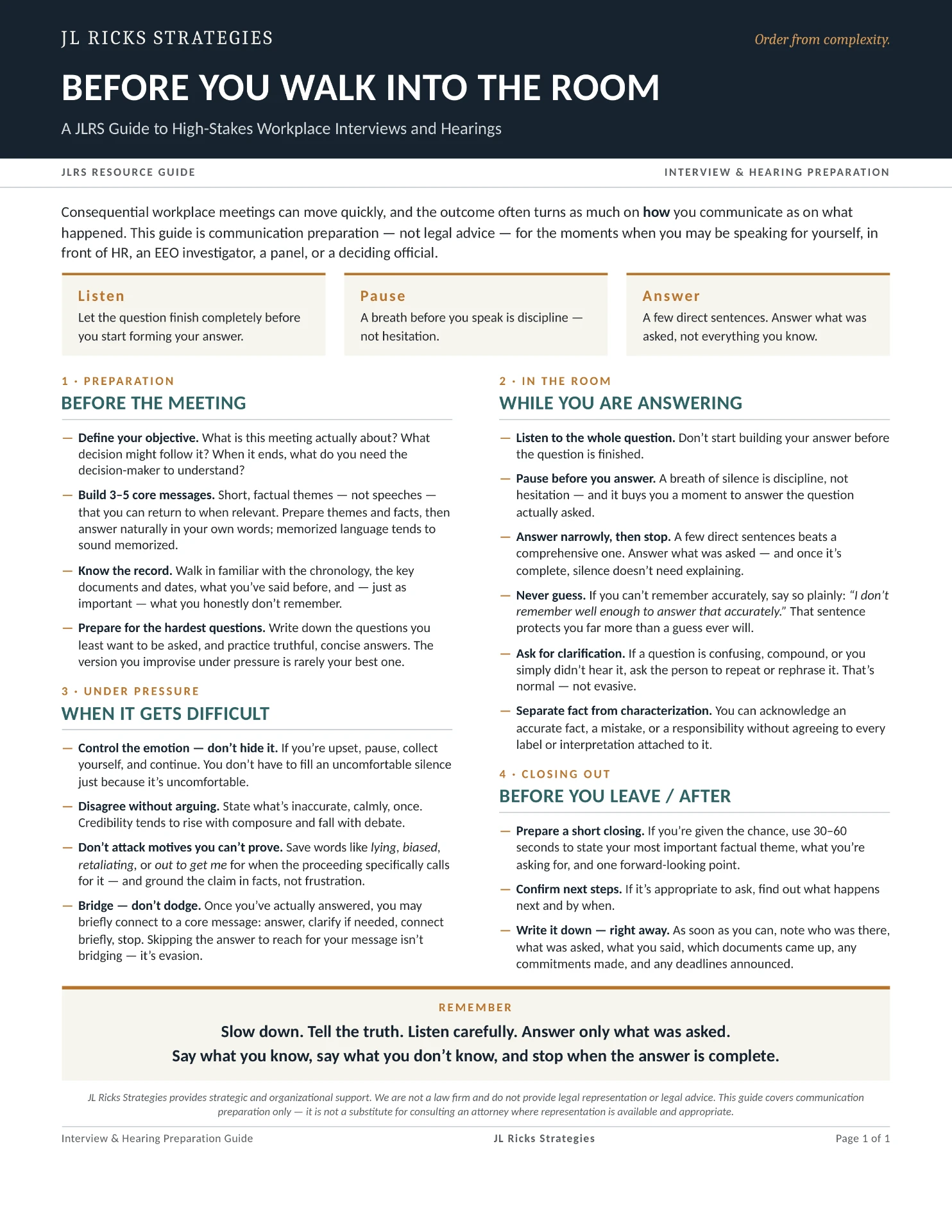
The full guide, as it prints — one page. Click the image to download the PDF.
The three beats
Listen. Pause. Answer.
Listen
Let the question finish
Pause
A breath is discipline
Answer
A few direct sentences
1 · Preparation
Before the meeting
Define your objective.
What is this meeting actually about? What decision might follow it? When it ends, what do you need the decision-maker to understand?
Build 3–5 core messages.
Short, factual themes — not speeches — that you can return to when relevant. Prepare themes and facts, then answer naturally in your own words; memorized language tends to sound memorized.
Know the record.
Walk in familiar with the chronology, the key documents and dates, what you have said before, and — just as important — what you honestly do not remember.
Prepare for the hardest questions.
Write down the questions you least want to be asked, and practice truthful, concise answers. The version you improvise under pressure is rarely your best one.
2 · In the room
While you are answering
Listen to the whole question.
Do not start building your answer before the question is finished.
Pause before you answer.
A breath of silence is discipline, not hesitation — and it buys you a moment to answer the question actually asked.
Answer narrowly, then stop.
A few direct sentences beats a comprehensive one. Answer what was asked — and once it is complete, silence does not need explaining.
Never guess.
If you cannot remember accurately, say so plainly: “I don’t remember well enough to answer that accurately.” That sentence protects you far more than a guess ever will.
Ask for clarification.
If a question is confusing, compound, or you simply did not hear it, ask the person to repeat or rephrase it. That is normal — not evasive.
Separate fact from characterization.
You can acknowledge an accurate fact, a mistake, or a responsibility without agreeing to every label or interpretation attached to it.
3 · Under pressure
When it gets difficult
Control the emotion — do not hide it.
If you are upset, pause, collect yourself, and continue. You do not have to fill an uncomfortable silence just because it is uncomfortable.
Disagree without arguing.
State what is inaccurate, calmly, once. Credibility tends to rise with composure and fall with debate.
Do not attack motives you cannot prove.
Save words like lying, biased, retaliating, or out to get me for when the proceeding specifically calls for it — and ground the claim in facts, not frustration.
Bridge — do not dodge.
Once you have actually answered, you may briefly connect to a core message: answer, clarify if needed, connect briefly, stop. Skipping the answer to reach for your message is not bridging — it is evasion.
4 · Closing out
Before you leave, and after
Prepare a short closing.
If you are given the chance, use 30–60 seconds to state your most important factual theme, what you are asking for, and one forward-looking point.
Confirm next steps.
If it is appropriate to ask, find out what happens next and by when.
Write it down — right away.
As soon as you can, note who was there, what was asked, what you said, which documents came up, any commitments made, and any deadlines announced.
Remember
Four sentences worth carrying in.
Slow down. Tell the truth. Listen carefully. Answer only what was asked. Say what you know, say what you don’t know, and stop when the answer is complete.
Boundaries
What this guide is, and is not.
JL Ricks Strategies provides strategic and organizational support. We are not a law firm and do not provide legal representation or legal advice.
This guide covers communication preparation only — it is not a substitute for consulting an attorney where representation is available and appropriate.
Next
Take the guide, or bring us the matter.
Subscribe
Get new JLRS writing by email
New essays on records, order, and institutional moments.